For a business, it's worth it when the problems are real and someone owns what happens the morning after. Without that owner, you get a good day and very little change.
The version that matters to a leadership team has little to do with software contests. Nobody codes, and the material on the table is your own.
How is a business AI hackathon different from a coding hackathon?
The word comes from software. A classic hackathon puts developers in a room, sometimes overnight, to build something that runs. A corporate AI hackathon keeps the deadline and the show-what-you-made ending, and changes nearly everything else.
The people in the room are the ones who do the work: the coordinator who builds the weekly report, the account manager who writes proposals, the supervisor who plans the jobs. The tools are the AI assistants your company has approved, used on your own documents with anything sensitive taken out.
The finish line moves as well. A coding hackathon judges what got built by the end of the event. A business hackathon is judged a month later, by whether anything from the day is still in use. The prototypes are rough on purpose. Each one only has to show a leader enough to decide whether to back it.
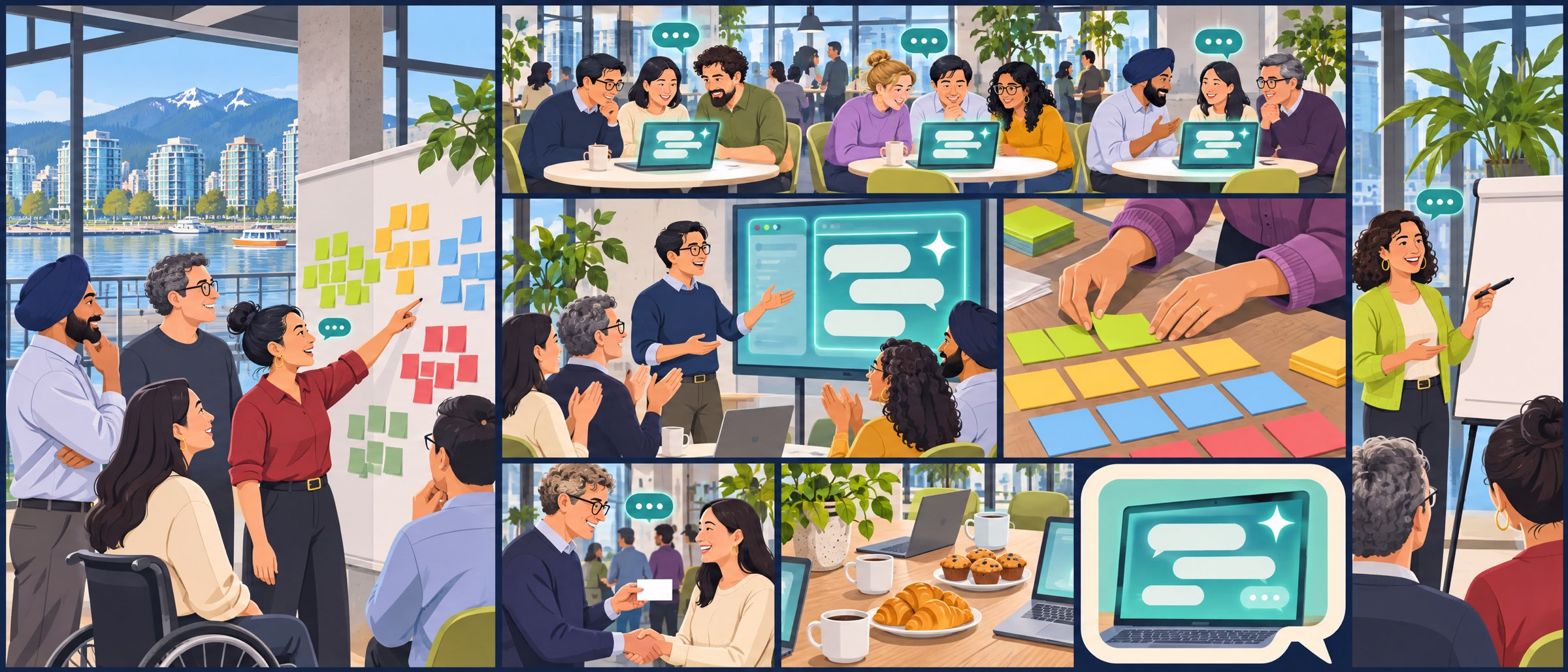
The NoW Hackathon, our signature format, works this way. It blends Design Thinking and Jobs To Be Done, it's non-technical, and it runs for a full day around "How might we" questions the team writes itself. We run the NoW Hackathon with AI. AI is how the room surfaces use-cases quickly and sorts them into a prioritized list of opportunities, which we call the AI Backlog.
What happens on the day?
A full day usually runs in this order.
Before the day
A short survey asks each person where their week goes and what they'd fix first. The answers decide which problems are worth the room's time.
The morning starts with guardrails
The group agrees which tools it can use, what information stays out of them and which decisions stay with people. Then the team turns its problems into "How might we" questions. A finance team, for example, might ask: how might we get the monthly variance commentary right the first time the controller reads it?
Small groups take one question each
They work with AI on their own material, and the use-cases they find along the way go onto the AI Backlog.
The afternoon ends with a show
Each group builds a rough prototype and presents it. The leaders in the room pick which ones get an owner.
The feel of the day matters more than leaders expect. People try things in front of colleagues that they wouldn't try alone at their desk. After a hackathon series we ran with The Career Foundation in June 2026, one participant put it this way.
"You put us in a safe container to just let our brilliance out... We need to keep tapping into this kind of brilliance through this innovative method." Evelyn Akselrod, The Career Foundation
When is an AI hackathon worth it, and when isn't it?
It's worth it when your people already use AI in patches and nobody has compared notes. The NoW AI Team Index, a staff survey of the organizations we work with, run from July to October 2026, shows how common that is. 31% of staff say their team has practical AI examples, and only 18% have received practical AI training relevant to their work.
The same survey shows why team examples are worth chasing. Among staff whose team has practical examples, 61% say AI is a regular part of how they work. Among staff whose team doesn't, it's 10%.
Team doesn't
10%disagreeTeam has practical AI examples
61%agree their team has examplesSource: The NoW AI Team Index, staff in organizations working with NoW, July to October 2026
A well-run hackathon produces exactly that kind of example: made by the team, on its own problems, in a day. What team examples have to do with AI use goes further into the finding.
It isn't worth it in three situations. The first is when the problems are chosen by someone outside the team, because people won't build hard on a problem they don't have. The second is when nobody who can approve the next step will be there or available that week. The third is when you expect a production system at the end of the day. A prototype still needs an owner, a check on the data it touches and testing on live work before anyone relies on it.
If you haven't yet agreed which tools are approved and what information stays out of them, settle that first. What is AI governance? covers what a first version looks like.
The honest test is simple. If you can't name who will own the best idea on Monday, wait until you can.
What should happen in the 30 days after?
A hackathon with no owner afterwards ends up where a pilot with no owner does, in Pilot Purgatory, where good ideas sit half-used until people forget them. The month after the day is where you prevent that.
In the first week, leadership reviews the AI Backlog
Pick one to three items. Give each a named owner, a measure and a date to report back.
In weeks two and three, owners test on live work
The people who built the prototype keep going, with a person checking the output before it goes anywhere.
In week four, the results go on the leadership agenda
Decide what to keep, change or stop, then pull the next item off the backlog.
Before the next round, use your own facilitators
The NoW Hackathon trains two or three facilitators inside your company, so the next session can run without us.
The backlog is what carries the day forward. A list with owners and dates gives people a reason to keep working on what they started.
Questions about AI hackathons
How long should an AI hackathon be?
For a business team, a full day. In half a day the framing tends to use up the time you need for building. Multi-day events suit developers building software.
Do people need technical skills to take part?
No. A business AI hackathon uses AI assistants your company has approved, on your own material. The skill that matters is knowing the work well.
What do you have at the end of an AI hackathon?
Rough prototypes on real problems, guardrails the team agreed together and a prioritized list of what to work on next. You won't have production systems, and you shouldn't treat a prototype as one.
Should leaders take part or stay out of the room?
Take part, at least for the afternoon. Someone has to decide which prototypes get an owner, and that decision lands better when the people who built them can see who made it.